History of Sewall Road
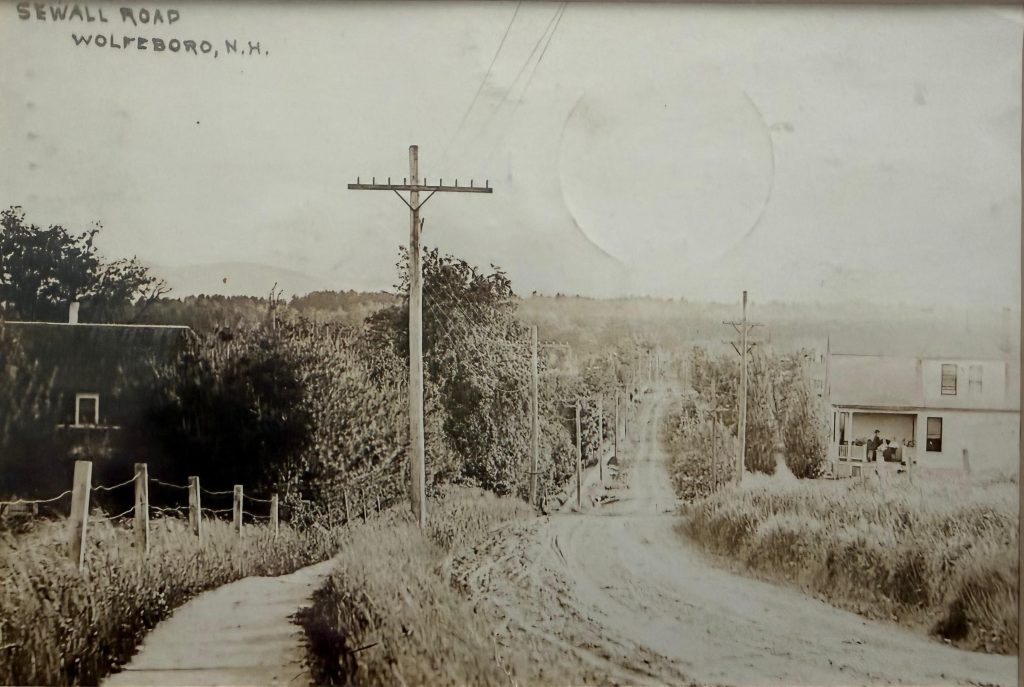
Postcard mailed August 4, 1914. Photo courtesy of a Sewall Road neighbor.
Explore more photographs and stories from Sewall Road’s past in our Historical Photo Gallery →
Winding along the eastern shores of Lake Winnipesaukee, between Wolfeboro Bay and Jockey Cove, Sewall Road has a rich history reflecting the evolution of Wolfeboro itself. From the Indigenous peoples who inhabited and traveled throughout the Lakes Region to early farming, grand waterfront estates, and today’s year-round neighborhood, the area has experienced remarkable changes over the centuries.
Before Sewall Road: Indigenous History
Long before European settlement, the Lake Winnipesaukee region was home to Indigenous peoples whose history stretches back thousands of years. The region is closely associated with the Abenaki peoples, including communities historically identified with the Winnipesaukee area.
Lake Winnipesaukee and its surrounding forests provided important resources for fishing, hunting, gathering, farming, and travel. Indigenous communities developed networks of waterways and trails connecting settlements and gathering places throughout the region.
One particularly interesting connection to the Sewall Road neighborhood is found at Carry Beach. The area was historically known as the “Carrying Place” or “Indian Carry,” where Indigenous travelers could carry canoes between Jockey Cove and Winter Harbor, avoiding the longer journey around Wolfeboro Neck.
Historical accounts and archaeological findings document Indigenous activity elsewhere around Lake Winnipesaukee, including significant settlements and fishing grounds near the Weirs. Wolfeboro’s history also records an Indigenous travel route following the general path of today’s Main Street.
Today, Abenaki communities continue to preserve and share their cultural heritage and connections to the lands and waters of northern New England.
The Sewall Land Grant (1759–1800s)
Sewall Road takes its name from David Sewall, one of the original proprietors associated with Wolfeboro’s establishment in 1759.
At a meeting of the proprietors in Portsmouth on November 14, 1759, Sewall served as clerk. When the proprietors’ land was divided in 1766, he received lot number sixteen, comprising approximately 440 acres along portions of Smith’s River and Wolfeboro Bay.
Sewall, born in York, Maine, in 1735, later became a prominent jurist. He served on the Massachusetts Superior Court and was appointed by George Washington in 1789 as a federal district judge for Maine, serving until 1818.
The surrounding area eventually became known as Sewall’s Point or Sewall Shore. Much of the land remained forested during Wolfeboro’s early development or was gradually cleared for agriculture. Timber harvesting, farming, and the establishment of early roads transformed the landscape.
Although ownership and land use changed over the generations, the Sewall name endured.
The Era of the Great Summer Estates (Late 1800s–1930s)
During the nineteenth century, Wolfeboro became an increasingly popular summer destination. The arrival of railroad service in 1872 helped make the town more accessible to visitors from Boston and other cities. The railroad extended to the Town Docks, where passengers could connect with lake steamships.
Wealthy seasonal residents were drawn to the lake’s natural beauty and began establishing substantial waterfront properties.
The first house on Sewall Road was Ferncliff, built in 1890 for Colonel Edward B. Dickinson of New York. The substantial waterfront estate included a 13-room residence, a distinctive windmill that supplied water, a boathouse, bathhouse, cottages, and a stone wharf.
Another notable property was Camp Wiscasset, a summer cottage associated with the Reverend A. Edwin Keigwin, a Presbyterian minister from Newark, New Jersey. Built in 1902, Wiscasset became a familiar landmark along the shoreline.
Other early summer residents included Ezra B. Bailey of New York and E. T. Milton of Massachusetts, whose property was known simply as “Milton’s.”
Despite their substantial size, many of these summer residences were known as “camps” or “cottages.” They reflected the architectural traditions of the period, with broad porches, lake views, natural materials, and carefully maintained grounds.
Before modern street addressing became commonplace, waterfront properties were frequently identified by their estate names or the families who owned them.
Lake Life and the Vesper Services
During the early twentieth century, life along Sewall Road was closely connected to Lake Winnipesaukee.
Boating was central to both recreation and transportation. Before roads were fully improved, traveling by water could be a convenient way for shoreline residents to reach downtown Wolfeboro and neighboring properties.
One particularly memorable neighborhood tradition was the lakeside vesper services associated with the Wiscasset estate.
Historical accounts describe outdoor religious gatherings featuring music and sermons, with attendees gathering along the shoreline and sometimes arriving by boat.
These services reflected the social and cultural life of Wolfeboro’s summer community and the important role the lake played in bringing people together.
From Summer Camps to Year-Round Homes (1940s–1960s)
Following World War II, Wolfeboro’s waterfront neighborhoods gradually changed.
Improvements in roads, utilities, heating, and construction made it increasingly practical to occupy former summer residences throughout the year.
Along Sewall Road, older camps were modernized, new homes were constructed, and the neighborhood developed into a mixture of seasonal and year-round residences.
These changes helped establish the residential character that continues today.
The Forest Road Connection (1960s)
For much of its history, Sewall Road developed through a series of extensions rather than as a continuous roadway.
The area around Carry Beach also looked quite different in earlier years. Around 1900, Forest Road followed the shoreline directly along the beach.
In 1966, Forest Road was relocated away from the waterfront. The following year, the final extension of Sewall Road connected it to Forest Road, establishing the roadway connection familiar to residents today.
The Wolfeboro Historical Society preserves photographs documenting these changes, including images of heavy equipment working on the roadway.
These photographs provide a valuable record of an important period in the neighborhood’s development.
Sewall Woods: Preserving the Natural Landscape
While much of Sewall Road’s shoreline developed into residential properties, nearby forestland has been preserved for future generations.
The Lakes Region Conservation Trust acquired land over a period of years to establish the Sewall Woods Conservation Area, protecting woodland and wildlife habitat near the neighborhood.
The property is owned by the Lakes Region Conservation Trust and co-managed by Wolfeboro XC Ski and the Town, with trail access on Clow St. near Pleasant Street. Today, Sewall Woods offers trails for cross-country skiing, walking, and biking, while also providing an opportunity to experience a quieter side of the neighborhood.
Sewall Road Today
Today, Sewall Road remains a distinctive residential neighborhood shaped by its lakeside setting, historic properties, natural surroundings, and generations of residents.
Although the neighborhood has changed considerably since the earliest days of Wolfeboro, its history remains visible in its homes, roads, stone walls, and shoreline.
Preserving that history is an ongoing community effort.
Share Your Sewall Road History
Do you have old photographs, postcards, maps, documents, or memories of Sewall Road you’d be willing to share?
We’re hoping to preserve and share more of our neighborhood’s history, from its historic homes and waterfront estates to the people, places, and events that have shaped it over the years.
Explore More of Sewall Road’s History
Visit our Historical Photo Gallery to see additional photographs, postcards, and stories from Sewall Road and Carry Beach.
If you have something to contribute, we’d love to hear from you! Please contact us. Any materials shared on the website will be published only with permission and appropriate credit.